
Offered on Ebay. Sold on 11/29/2007 for $25.
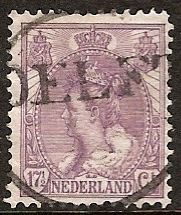
When I saw this cancel on eBay I did not recognize it.
Although at first sight it appears that the Delft cancel is a roundcancel,
we’ll see that we’ll have to
assume that in reality it is a combination of a worn round (date) cancel and an
old straightline cancel.
After the bidding closed I contacted the buyer
and asked him about the history of
this cancel. The buyer put me on
the right track, by pointing out the literature where this cancel is mentioned.
In chronological order this is what’s written about it.
Vellinga1 (1933) writes: Through Circular #
528 of February 13, 1857 it was pointed out that the use of cancels, not
previously approved by the postal authorities and used at some
postoffices, were not
allowed. Known are cancels
(Vellinga type 41 (V 41)), of
Amersfoort and Delft.
Korteweg2 (194?) : February 13, 1857. Ban
on the use of fantasy products. Only officially supplied cancels can be used by
postoffices.
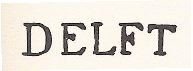
Korteweg then shows Korteweg type 46 (K 46), which is
reproduced here.
In 1955 van der Willigen’s3 publication
there is a chapter on Falsifications. It shows two examples of the Delft
cancel; one on the 5 cent 1852 issue, the other one on a 25 cent Wilhelmina fur
coat issue.
Van der Willigen writes: A rather common combination
is that of a normal cancellation together with a fairly large straightline
cancel DELFT. This is probably the just in 1829 renewed straightline cancel (V
21) that shortly thereafter was replaced by the first date cancel (V 25).
Contrary to sub postoffices (hulpkantoren) the main postoffices were not
allowed to use this type of cancel. I have not seen it as the only cancel (not
in combination with another cancel) on a stamp of the first issue or on a
cover. Strangely quite a few
stamps of the fur coat
issue (1898) and some of the Jubilee issue (1913) were canceled with this postmark, which gives reason to
believe that during the period 1913-1915 this cancel was put into use again,
mainly to be used on packages, and other mail with an irregular surface. For
this type of mail it was mandatory to cancel the stamps using some straight
line cancels. We assume that during that period a postal employee saw a chance
to make some money by applying this ‘rare’ cancel to the first issue.
Hoogerdijk4 also shows the cancel, with
the following text: The old
straightline cancel Delft was used for packages around 1915. Value is fl 25 on the fur coat and Jubilee
issue. This cancel is most likely also used on stamps of the first and
second issue.
Specialiteiten Catalogus5 notes: On all
three denominations of the first issue one can find the straightline cancel (K
46) DELFT (with Egyptian ( with serifs) lettering). Van der Willigen (1955) is
of the opinion that we are dealing with a falsification. Although Korteweg, in
his publication gives it its own number (K 46), but that refers to the ban on
fantasie products. K 46, for the same reason could listed under K 15, K 19, K 27, K 30A(cut), or K 41.
Because DELFT is mainly found in combination with halfround cancels situated
along railroads, it makes sense to think
that we might be dealing
with some type of railroad cancel.
The value varies from 250 Euros for a combination cancels on the 5 ct and 10 ct
denominations up to 500 Euros for combination cancels on the 15 ct.
denomination and 5 ct and 10 ct
only DELFT (not in combination with another cancel).
Well, there you have it. What can we conclude?
To me it appears that we are dealing with a real
cancel, used originally around 1856/57 and later put into use again. Although
this cancel was not approved by the PTT cancellation of stamps of the first
issue should not be considered ‘maakwerk’ in my opinion.
During the 1910s the cancel was used once more on the
fur coat and Jubliee issues, and after this cancel had been declared
‘hands-off’ in 1857 I would call this an illegal use of it.
Comments to the ASNP editor are of course welcome.
References:
1: O.M. Vellinga, De Poststempels van Nederland,
1676-1915, NBPV , 1990 Reprint
2: P.C.Korteweg,
300 Jaar Postmerken van Nederland, 1570-1870, NBFV, 1985 Reprint
3: A. van der Willigen, Afstempelingen Emissie 1852
van Nederland, Uitgeverij Davo, Deventer, 1955
4: D.C. Hoogerdijk, De Naam- of Langstempel van
Nederland, Uitgeverij De Munnik, ‘s Gravenhage, 1972
5: Specialiteiten Catalogus 2006-2011, NVPH, 2006
With thanks to Martin Bos, Wageningen, the
Netherlands.